AI Phone Answering for Restaurants: Complete Guide 2026
AI phone answering systems use natural language processing and conversational AI to handle incoming calls just like a trained host would.
Jan 5, 2026
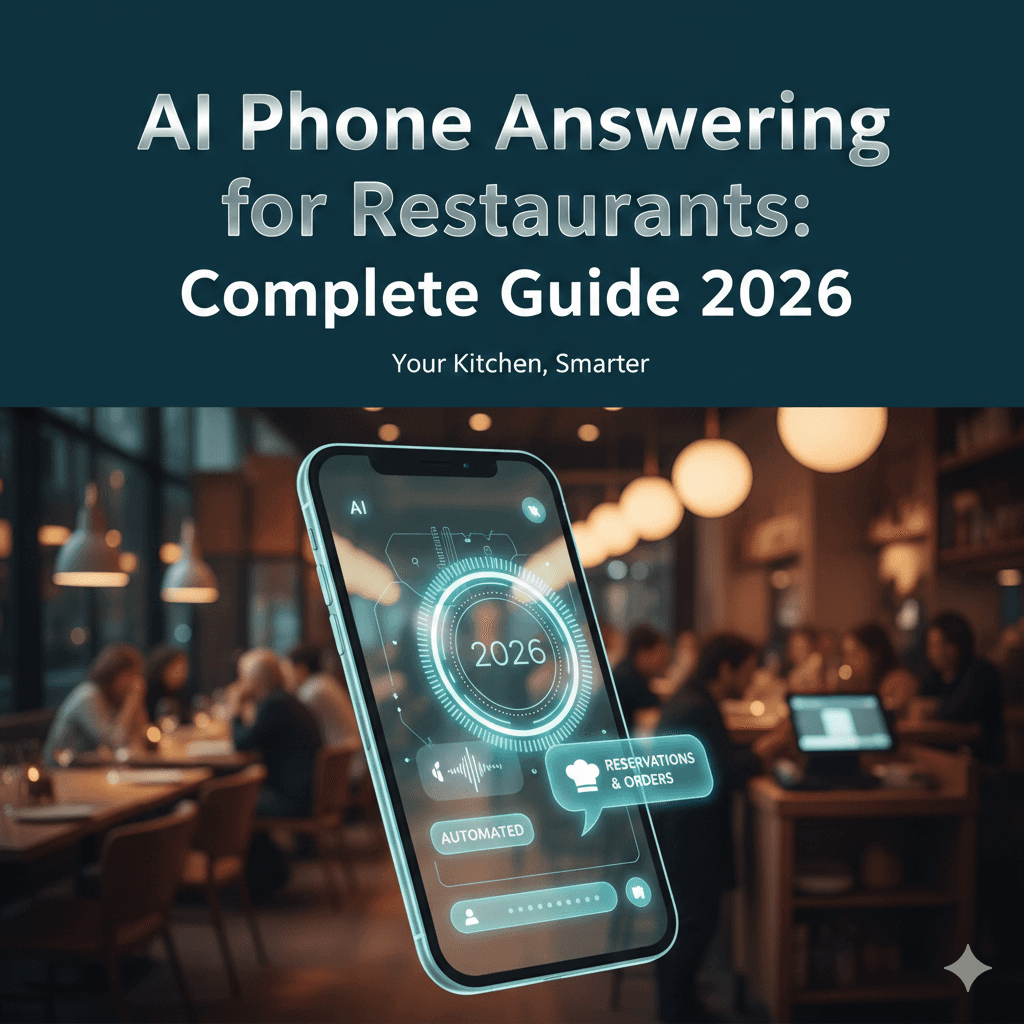
How AI Phone Systems Are Transforming Restaurant Operations and Revenue
Every unanswered phone call costs your restaurant money. When the phone rings during dinner rush and your staff can't answer, you're not just losing an order—you're losing a customer to your competitor. In 2026, AI phone answering systems have shifted from "nice-to-have" to essential infrastructure for restaurants of all sizes.
This comprehensive guide breaks down everything you need to know about AI phone answering for restaurants, from how the technology works to pricing comparisons and why more operators are making the switch.
What Is AI Phone Answering for Restaurants?
AI phone answering systems use natural language processing and conversational AI to handle incoming calls just like a trained host would. When a guest calls, the AI instantly recognizes their intent—whether they want to place an order, make a reservation, or ask about menu items—and responds naturally with accurate information.
Think of it as a virtual host that never takes a break. Modern restaurant phone systems powered by AI can:
Answer 100% of calls instantly, even during peak hours
Handle multiple calls simultaneously without putting anyone on hold
Take complex orders with modifications and special requests
Process payments securely over the phone
Sync directly with your POS system for seamless operations
Provide 24/7 coverage, capturing late-night and early-morning opportunities
The technology has advanced to the point where customers often can't tell they're speaking with AI. The conversation flows naturally, with appropriate pauses, empathy, and the ability to understand how people actually talk.
Why Restaurants Are Adopting AI Phone Systems in 2026
The restaurant industry faces a perfect storm of challenges that make AI phone answering not just helpful, but essential:
The Labor Crisis
The restaurant industry experiences an average annual turnover rate of 79.6%, and 45% of operators report insufficient staffing. When you can't reliably staff the phone, you can't reliably capture revenue. AI fills this gap by providing consistent phone coverage regardless of staffing challenges.
Massive Revenue Loss from Missed Calls
Research shows that restaurants receive between 800-1,200 calls monthly, but only 30% have systems capable of answering all calls effectively. Industry data reveals that 20-25% of calls go unanswered during peak hours—that's 200-300 missed opportunities per month for an average restaurant.
For a restaurant with a $45 average ticket, missing just 20% of calls translates to $10,800 in lost monthly revenue. Over a year, that's nearly $130,000 walking out the door.
The Phone as a Revenue Channel
Forward-thinking operators now treat phone performance as a measurable, optimizable revenue channel—just like tables, delivery, and online orders. With AI, restaurants can track exactly how many calls they're capturing, average order values, and which menu items get the best upsell conversion.
Restaurants using AI phone answering report phone order revenue increases of 23-26%, not through more calls, but by capturing every call and consistently suggesting add-ons.
This was the first year I took my kids trick-or-treating on Halloween. I actually got to leave early because Loman was answering the phones." — Dru, Midland Pizza Co.
How AI Phone Answering Works for Restaurants
The setup and operation are simpler than most restaurant technologies:
Setup Process
Initial configuration (typically under 24 hours)
Connect your existing phone number or get a new one
Upload your menu and customize responses
Integrate with your POS system
Set up payment processing
Training phase
The AI learns your menu, policies, and typical customer questions
You can customize the voice, tone, and personality to match your brand
Test calls ensure everything works perfectly
Go live
Calls start routing to your AI system
Staff continues normal operations without interruption
Daily Operations
When a customer calls:
AI answers instantly with a natural greeting
Understands the request through conversational AI
Handles the interaction based on intent:
Takes detailed orders with all modifications
Makes or modifies reservations
Answers menu questions and allergen information
Provides hours, directions, and wait times
Processes payment securely if ordering
Sends order directly to POS or kitchen display
Escalates to staff only when necessary
The entire process happens seamlessly, and your staff receives clean, accurate information without phone interruptions.
Key Benefits of AI Phone Answering for Restaurants
1. Never Miss a Call Again
AI systems handle every call, even when your staff is busy serving diners. No more lost orders during rush hours or after-hours missed opportunities.
Real impact: Restaurants typically recover $15,000-$25,000 in annual revenue just from capturing previously missed calls.
2. Handle Rush Hour Without Breaking a Sweat
Unlike human staff who can handle one call at a time, AI manages multiple incoming calls simultaneously. No hold times, no busy signals, no frustrated customers.
3. Perfect Order Accuracy
AI systems achieve 95-98% order accuracy rates, surpassing the industry standard of 89%. Orders are recorded consistently with all modifiers and special requests, reducing kitchen errors and food waste.
4. Free Your Staff to Focus on Guests
Front-of-house and kitchen staff can concentrate on serving diners instead of being interrupted by constant phone calls. Restaurants report saving 100-200 hours monthly in staff phone time.
5. Consistent Upselling
AI never forgets to suggest add-ons, upgrades, or specials. It follows your upselling scripts perfectly on every single call, driving higher average ticket values.
6. 24/7 Availability
Capture early-bird reservations, late-night orders, and off-hours catering inquiries. Your phone system works when your restaurant is closed, expanding your revenue opportunities.
7. Valuable Analytics
Modern systems provide detailed insights:
Call volume by time of day
Answer rates and missed opportunities
Average order values
Most-requested menu items
Peak calling times for better staffing
8. Multilingual Support
Many AI systems support multiple languages, allowing you to serve diverse communities without hiring multilingual staff.
Restaurant Phone System Pricing: What to Expect in 2026
Understanding the true cost of AI phone answering requires looking beyond monthly fees. Here's the complete breakdown:
Pricing Models
1. Flat-Rate Subscription ($99-$599/month) Most common model with predictable monthly costs. Typical range:
Basic plans: $99-$199/month
Mid-tier plans: $200-$399/month
Premium plans: $400-$599/month
Features typically scale with price: call volume limits, advanced integrations, analytics depth, and customization options.
2. Per-Minute Pricing ($0.15-$1.00 per minute) Some providers charge based on actual conversation time. This can work for low-volume restaurants but becomes expensive quickly at scale.
3. Hybrid Models Combine base subscription with usage overages. Offers predictability while accommodating seasonal fluctuations.
What Affects Your Cost
Call volume limits - Higher tiers allow more concurrent calls
Integration requirements - POS, reservation systems, payment processing
Customization level - Custom voices, specialized workflows
Feature depth - Basic answering vs. full order processing
Support level - Self-service vs. dedicated account management
Hidden Costs to Watch For
Setup fees ($0-$500 one-time)
Per-minute overages after included allowance
Peak hour multipliers (some charge 2-3x during dinner rush)
Payment processing fees (typically 2.9% + $0.30 per transaction)
POS integration fees (one-time or monthly)
Cost vs. Value: The ROI Calculation
Compare AI costs against alternatives:
Full-time receptionist:
Salary: $35,000-$45,000/year
Benefits (25-35%): $8,750-$15,750/year
Total: $44,000-$60,000/year ($3,700-$5,000/month)
AI phone system:
Average cost: $2,400-$4,800/year ($200-$400/month)
Savings: 93-95% vs. human staff
Additional revenue recovery:
Missed calls captured: 200-300/month
Conversion rate: 50%
Average order: $45
Additional revenue: $4,500-$6,750/month
The math is compelling. Most restaurants achieve positive ROI within the first quarter.
Comparing Top AI Phone Answering Platforms for Restaurants
The market has matured significantly in 2026. Here's how leading platforms stack up:
Full-Service Order Automation Platforms
These handle the complete transaction from greeting to payment:
Key Features:
Complete order taking with modifications
Secure payment processing
Direct POS integration
Reservation management
24/7 operation
Best for: Pizza shops, Chinese takeout, wings, and any restaurant where phone orders drive significant revenue
Price range: $199-$499/month
Implementation: 24-48 hours typical
Reservation-Focused Systems
Specialized in handling table bookings and guest inquiries:
Key Features:
Reservation scheduling and modifications
Table availability checking
Guest questions and FAQ handling
Integration with OpenTable, Resy, SevenRooms
Best for: Full-service restaurants, fine dining, upscale casual
Price range: $150-$350/month
Hybrid Human + AI Services
Combine AI efficiency with human backup for complex scenarios:
Key Features:
AI handles routine calls
Human agents take complex requests
Premium white-glove service
Higher accuracy for nuanced situations
Best for: High-end establishments where personalization matters most
Price range: $300-$800/month
Why AloChef Stands Out for Restaurant Phone Automation
While many AI phone systems claim to help restaurants, AloChef is purpose-built specifically for restaurant operations with several key differentiators:
Toast POS Integration Excellence
AloChef integrates seamlessly with Toast, the leading restaurant POS system. This means:
Orders flow directly to your kitchen with zero manual entry
Menu updates sync automatically
Payment processing through your existing Toast setup
Real-time inventory considerations
True Order Automation
Unlike systems that just answer calls and take messages, AloChef completes the entire transaction:
Understands complex order modifications
Handles group orders efficiently
Processes secure payments
Confirms delivery addresses and times
Manages upsells contextually
Restaurant-Specific Training
AloChef's AI is trained on hundreds of thousands of actual restaurant call transcripts, understanding:
How customers describe menu items informally
Common modification requests
Typical questions about ingredients and allergens
Regional language variations and preferences
Pricing Built for Solo Founders and Small Operations
AloChef offers transparent pricing designed for independent restaurants and small chains:
No hidden per-minute charges
Predictable monthly costs
Free trial period to test with real calls
No long-term contracts
Setup Designed for Speed
Most restaurants are live within 24 hours:
Simple menu upload process
Pre-built Toast integration
Minimal technical knowledge required
Hands-on support during onboarding
Built by Restaurant People
AloChef was created by a solo founder who understands the challenges of running lean operations. The platform is designed to maximize automation, minimize maintenance, and deliver measurable ROI from day one.
Implementation Best Practices
To get maximum value from your AI phone system:
Before Launch
Audit your current phone performance
Track missed calls for 2 weeks
Calculate average order value
Identify peak call times
Document common customer questions
Prepare your menu
Ensure descriptions are clear and accurate
Note common modifications
List allergen information
Define upsell suggestions
Train your team
Explain how the system works
Set expectations for escalations
Define roles for handling edge cases
During Launch
Start with soft launch
Route a percentage of calls to AI first
Monitor performance closely
Gather customer feedback
Adjust scripts and responses
Test extensively
Place test orders with modifications
Try complex scenarios
Verify POS integration accuracy
Check payment processing
After Launch
Review analytics weekly
Track answer rates
Monitor order accuracy
Calculate revenue impact
Identify improvement opportunities
Optimize continuously
Refine menu descriptions based on questions
Update upsell suggestions based on performance
Add new capabilities as needed
Gather customer feedback
Survey callers about their experience
Monitor online reviews mentioning phone orders
Ask staff about call quality issues
Common Concerns and How AI Addresses Them
"Will customers be upset they're talking to AI?"
Modern AI sounds remarkably human. Many restaurants report that customers don't realize they're speaking with AI until told. The key is natural conversation flow, appropriate responses, and seamless handling of requests.
For customers who prefer human interaction, systems can quickly transfer to staff with full context of the conversation.
"What about complex special requests?"
Advanced AI systems handle complex modifications well:
"No onions, extra cheese, light sauce"
"Gluten-free bun, but don't cross-contaminate"
"Half pepperoni, half mushroom, cut into squares"
For truly unusual requests, the AI captures the details and routes to staff with notes.
"How does it handle angry customers?"
AI systems are trained to recognize frustration and de-escalate professionally. They can:
Acknowledge concerns empathetically
Offer immediate solutions within parameters
Transfer to managers seamlessly when needed
Never get emotional or defensive
"What if the system makes mistakes?"
Modern systems have built-in verification:
Order read-back before confirmation
SMS order summaries sent to customers
Clear correction processes
Staff override capabilities
And with 95-98% accuracy rates, they make fewer mistakes than human order-takers.
The Future of Restaurant Phone Systems
Looking ahead, restaurant phone automation will continue evolving:
Predictive Calling
AI will analyze patterns to predict high-volume times and proactively suggest staffing adjustments.
Dynamic Menu Optimization
Systems will track which items are mentioned in calls vs. actually ordered, helping optimize menu descriptions and positioning.
Integration Expansion
Deeper connections with kitchen management systems, inventory, and supply chain tools for end-to-end automation.
Voice Analytics
Advanced sentiment analysis to identify customer satisfaction trends and potential issues before they become problems.
Personalization at Scale
Recognition of repeat callers with order history and preferences, creating VIP experiences automatically.
Is AI Phone Answering Right for Your Restaurant?
AI phone systems deliver the most value for:
High-Volume Phone Order Restaurants
Pizza shops
Chinese takeout
Wing spots
Sandwich shops
Any concept where phone orders are primary
Staffing-Challenged Operations
Struggling to find reliable phone staff
High turnover rates
Can't afford dedicated phone person
Growth-Focused Operators
Multi-unit operators scaling locations
Franchises needing consistency across locations
Restaurants expanding delivery territory
Quality-Focused Establishments
Want perfect order accuracy
Need detailed allergen information handling
High standards for customer service
Getting Started with AI Phone Answering
Ready to stop missing calls and start capturing more revenue? Here's your next steps:
1. Calculate Your Missed Call Cost
Track your unanswered calls for one week. Multiply by your average order value. That's your monthly opportunity.
2. Evaluate Your Needs
Consider:
Primary use case (orders, reservations, or both)
POS system integration requirements
Call volume expectations
Budget constraints
3. Test with Real Calls
Most services offer free trials. Test with actual customer calls before committing.
4. Start Small and Scale
Begin with one location or partial call routing. Expand as you see results.
5. Measure Everything
Track answer rates, order accuracy, revenue impact, and staff time saved. Use data to optimize.
Why AloChef Is the Smart Choice for Restaurant Operators
When it comes to AI phone answering for restaurants, AloChef delivers the complete package:
✓ Purpose-built for restaurant operations - Not a generic AI service adapted for restaurants
✓ Seamless Toast POS integration - Orders flow directly to your kitchen with zero friction
✓ True end-to-end automation - From greeting to payment to POS ticket
✓ Transparent, predictable pricing - No per-minute charges or hidden fees
✓ 24-hour implementation - Get live and capturing calls quickly
✓ Built for solo founders and small chains - Designed for lean operations
✓ Proven results - Restaurants recover $15K-$25K annually in missed orders
The restaurant industry in 2026 demands technology that actually works, integrates seamlessly, and delivers measurable ROI. AloChef checks every box.
Take Action: Stop Losing Revenue to Missed Calls
Every day without AI phone answering is another day of lost revenue. The average restaurant loses $10,800 monthly in missed calls—over $130,000 annually.
The technology is proven. The ROI is clear. The implementation is fast.
Ready to capture every call and grow your revenue?
Start your free trial with AloChef today and see how AI phone answering transforms your restaurant operations. No credit card required. Get live in 24 hours.
Last updated: January 2026
Keywords: ai phone answering restaurant, restaurant phone system, automated phone orders, restaurant AI, phone automation for restaurants, Toast POS integration, restaurant order automation, AI voice assistant restaurant
Frequently Asked Questions
How much does AI phone answering cost for restaurants? Most restaurants pay between $199-$499 per month for full-featured AI phone systems. This is 93-95% cheaper than hiring a dedicated phone staff member and typically generates $15,000-$25,000 in recovered revenue annually.
Will customers know they're talking to AI? Modern AI systems sound remarkably human with natural conversation flow. Many customers don't realize they're speaking with AI. Systems also seamlessly transfer to human staff when needed.
How quickly can I implement AI phone answering? Most restaurants are live within 24-48 hours. Setup involves connecting your phone number, uploading your menu, and integrating with your POS system.
Does it work with my existing POS system? Leading AI systems integrate with major restaurant POS platforms including Toast, Square, Clover, and others. Always verify integration compatibility before committing.
What happens if the AI can't handle a call? Advanced systems recognize when they need help and seamlessly transfer to your staff with full context of the conversation. This happens in less than 5% of calls for well-configured systems.
Can AI handle complex orders with modifications? Yes. Modern AI understands complex order modifications, allergies, special requests, and group orders. Order accuracy typically exceeds human performance at 95-98%.
Is my customer data secure? Reputable AI phone systems are PCI-DSS compliant for payment processing and follow strict data security protocols. Always verify security certifications before choosing a provider.
What if call volume exceeds my plan limits? This depends on your pricing model. Flat-rate plans typically allow unlimited calls. Usage-based models may charge overages. Review terms carefully and choose a plan that accommodates your peak volumes.